
An Insider’s View of Building 10 Movable Pews for Holy Cross Chapel in Sedona, Arizona
Click here to open index.
April 30, 2024 – February 24, 2025
During that timeframe a lot happened. It started with a brief email from a chapel coordinator and ended with us hauling hundreds of pounds of pew parts up the ramp at the famous Sedona landmark. I should insert a scenic picture here but we were too busy hoisting wood to brandish phones.
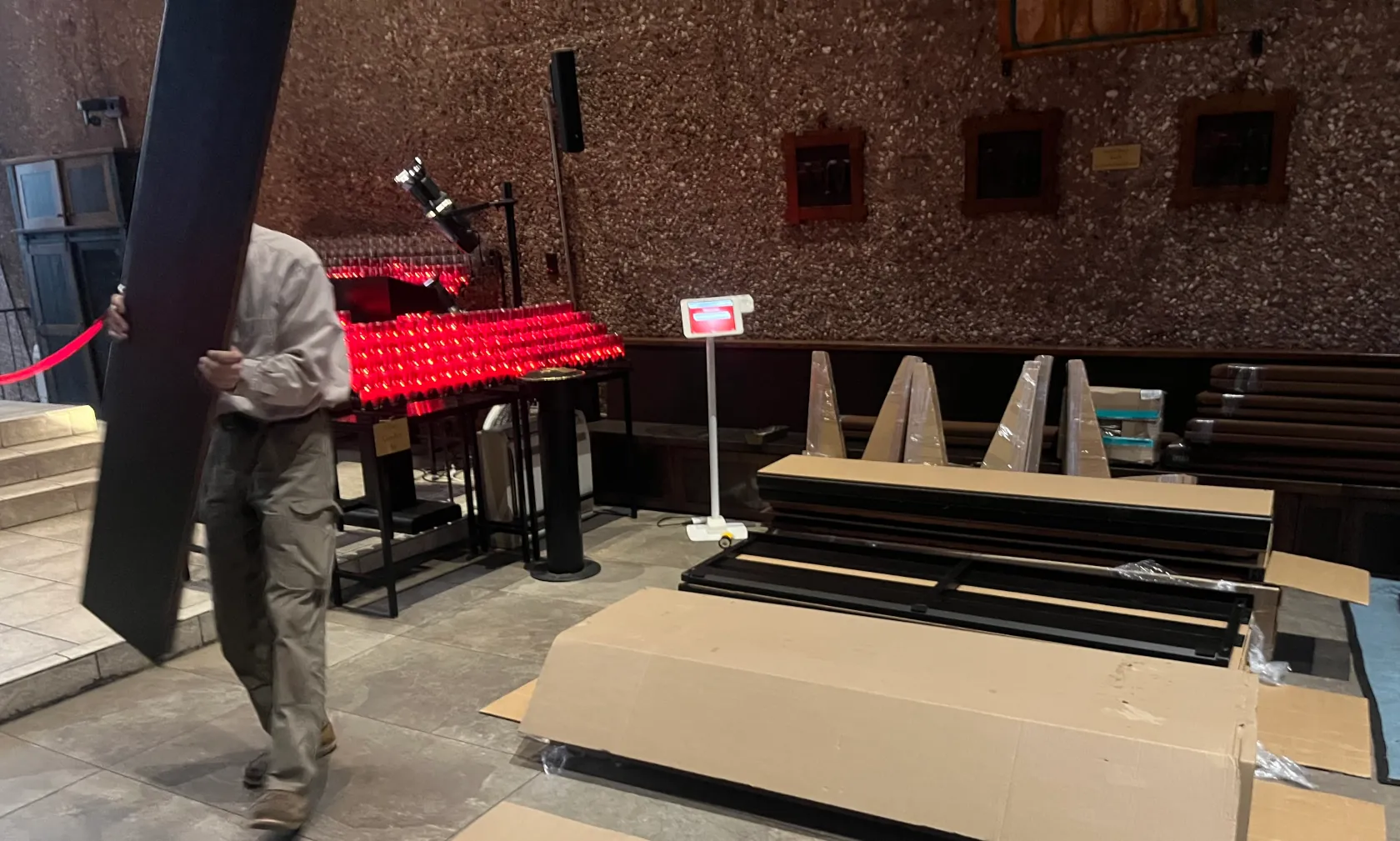
Instead, you get an interior shot of us unpacking. This happened after 5pm MST when the chapel closed for the night.
Project Scope: the Request and Client Specifications
This chapel is unique. It (of course) has no official parishioners, only has Mass twice a week and is very small. Yet, as a major Arizona landmark, it sees millions of feet walking through its doors. This is what happens when a place of worship intersects with tourist season in Sedona. When the time came for new pews, they naturally had a firm list of requirements:
- 10 pews, each 72″ long
- simple design with open back and open ends
- padded kneelers
- moveable – no floor anchors
- red oak stained dark to match existing woodwork
- durable enough to handle roughly 2 million visitors per year
- visual match for the chapel interior
That was gleaned from the first email but one important detail was missing. The pews need to move but how easily? A followup email answered that question: make them heavy for maximum stability.
- heavy, two people can move it, minimize wandering
Not Our First Pew Rodeo: Pews That Move
Back in 2013, we designed two pews for a small oratory and published a pair of articles on our blog.
Designing New Chapel Furnishings
Building Two Pews
Those pews were freestanding with folding kneelers. For Sedona’s pews, no reinvention needed, merely minor adaptations and improvements. This prior experience may be a big part of why we were awarded the commission. The chapel coordinator noted our experience and willingness to build moveable pews. Since most churches fasten them to the floor, portable options from manufacturers are rare and few custom studios have experience building pews with kneelers.
Quibbling With the Shakers: Form and Function In Pew Design
Form follows function or so they say. Our philosophy is form and function with neither aspect sacrificed for the other. This is wrangled in the early design phase where the two become intertwined and oftentimes compete for dominance.
So how do we start? Each project is different. For this one, we used the original pews as form inspiration (see photo). This honored the request for simplicity and pays homage to the craftsmen who created the pews preceding ours. It is an addition to the next chapter of history, not a jarring shift that treats visitors’ eyes like an ocular yo-yo, wrenched between warring aesthetics.
Our 2013 pews were tapped for function and anthropomorphic details and we came up with this for the first iteration:
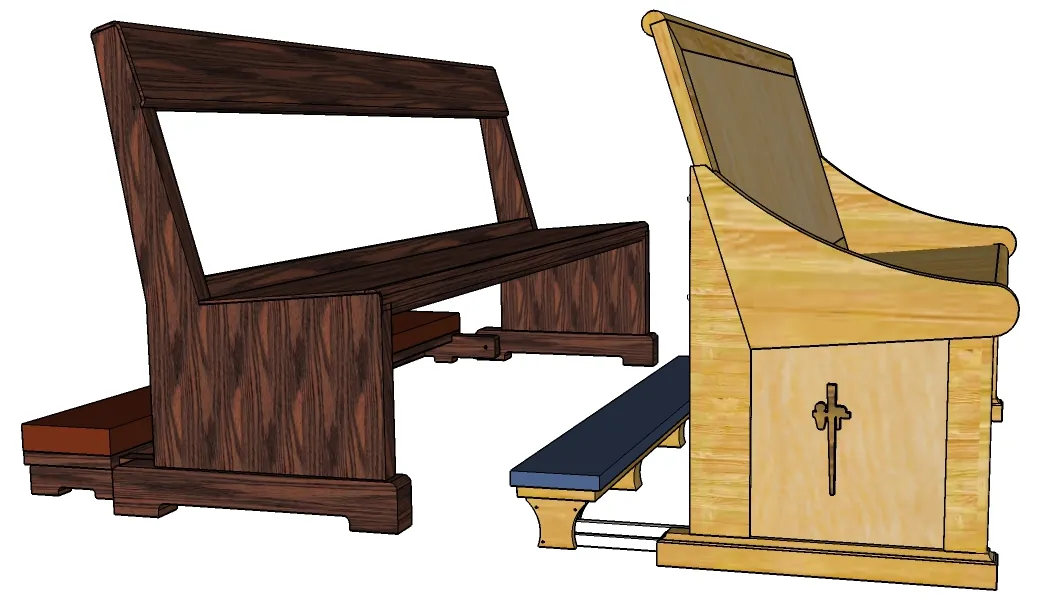
Note the similar seat height and angles but Sedona’s version (left) has open ends with a clean transition between the slab sides and seat. The kneelers look very different but share critical dimensions.
Key changes:
- Conventional kneeler pivot – simpler, cheaper, fewer moving parts. Parallel-action kneelers worked fine for the 2013 private oratory. But at Holy Cross, they would potentially see over a million cycles each year.
- Reshaped feet – flat feet rock and slide more easily on uneven floors. The new arch design makes contact only at the ends for improved stability and has a more elegant look.
The client requested two alterations and we arrived at the finished version.
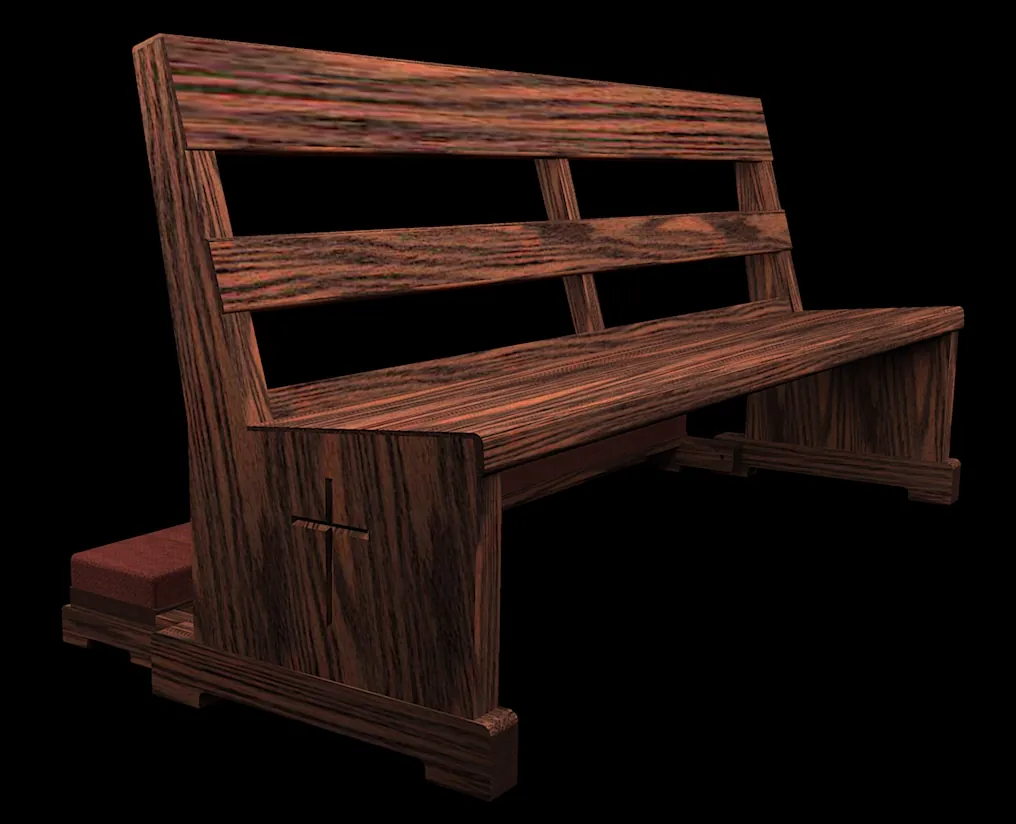
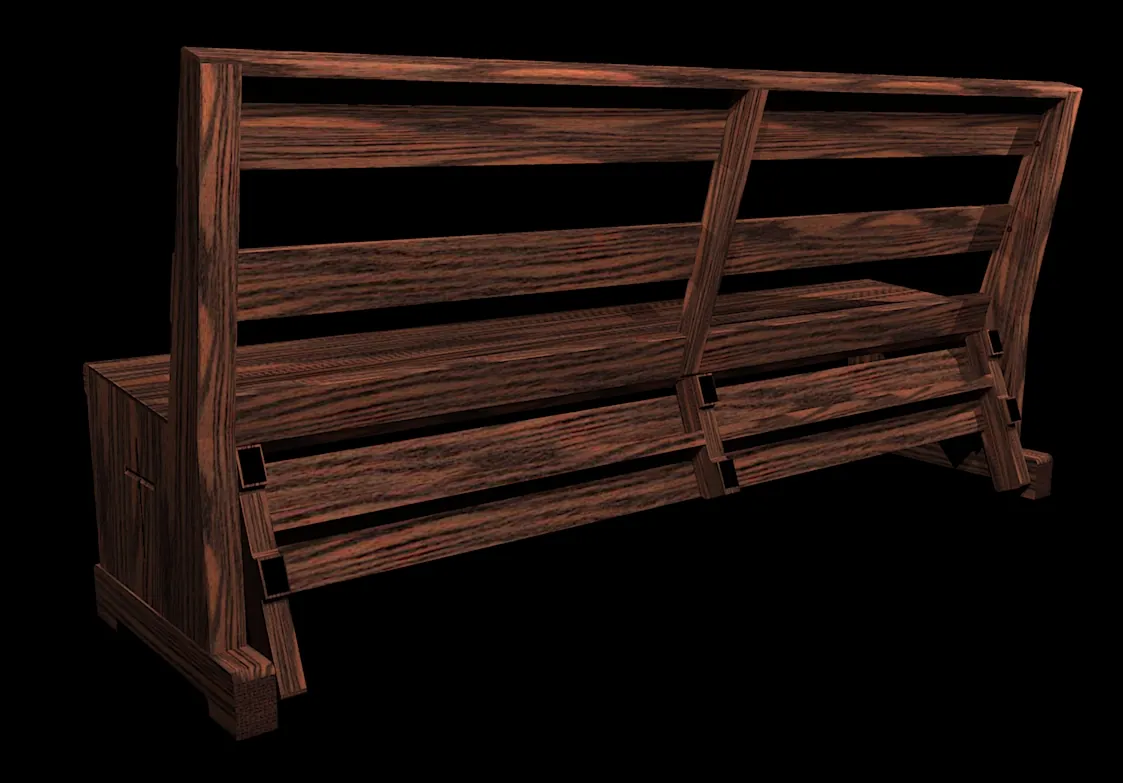
Additions:
- Crosses engraved on both sides.
- An extra plank for the back.
- A center support to stiffen the middle plank.
Hashing Out Function: Design Meets Physics
With the general function and appearance fleshed out, it is time to make this design viable for real world use. The details involved are numerous. Here, I will focus on four aspects we dealt with as we refined a set of working drawings.
No Wandering Desired
A drawback of movable pews is they get nudged out of place as people sit and stand. To reduce this to a minimum, we adopted the following approach:
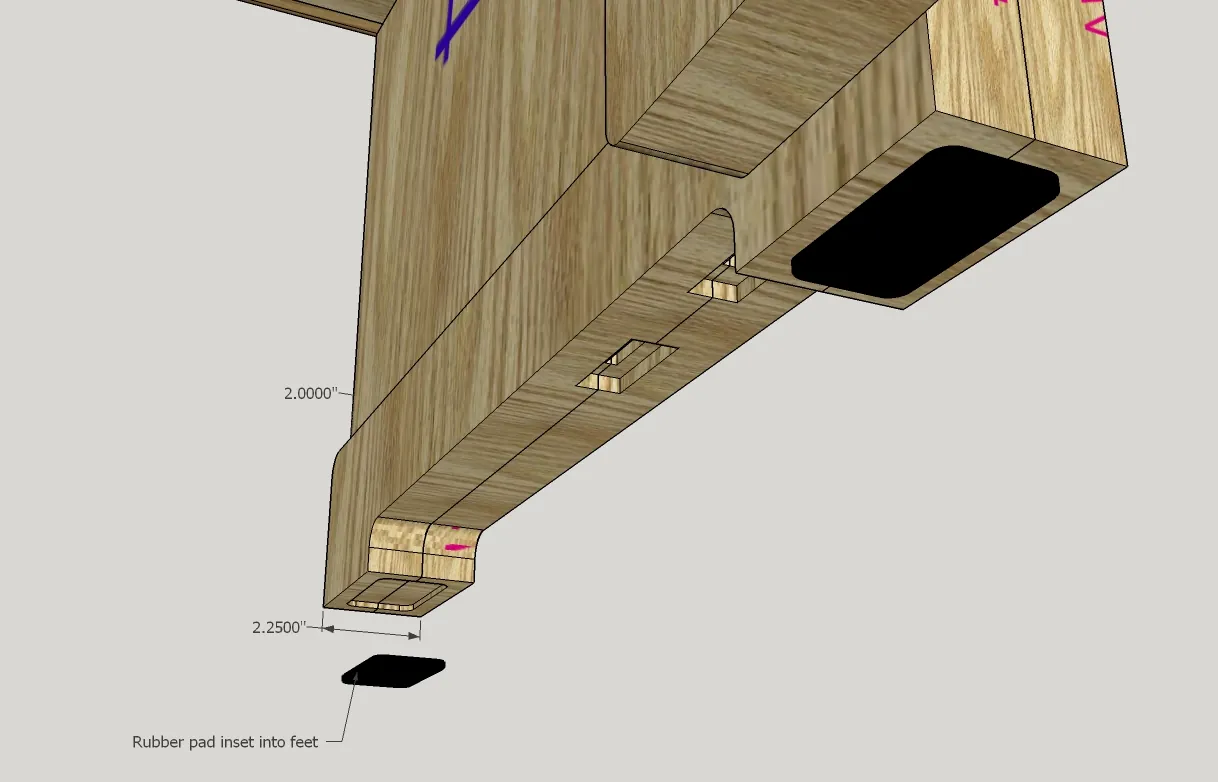
- More mass and lower center of gravity – sides and feet were beefed up with the target weight for a finished pew exceeding 80 pounds.
- Rubber feet – custom made of soft, textured, non-slip rubber to fit inside pockets cut into the feet.
Long-Distance Stain Matching
Because this customer provided most specs upfront, no onsite consultation was needed. Instead of travel fees to get a stain match, we shipped a range of samples bracketing their photo reference.
Normally customers begin by sending us a sample but not this time. They provided pictures of their woodwork. Pictures and monitors cannot be trusted for color reference but it’s a start. (Why is color matching to a photo a problem? Learn here.)
The process:
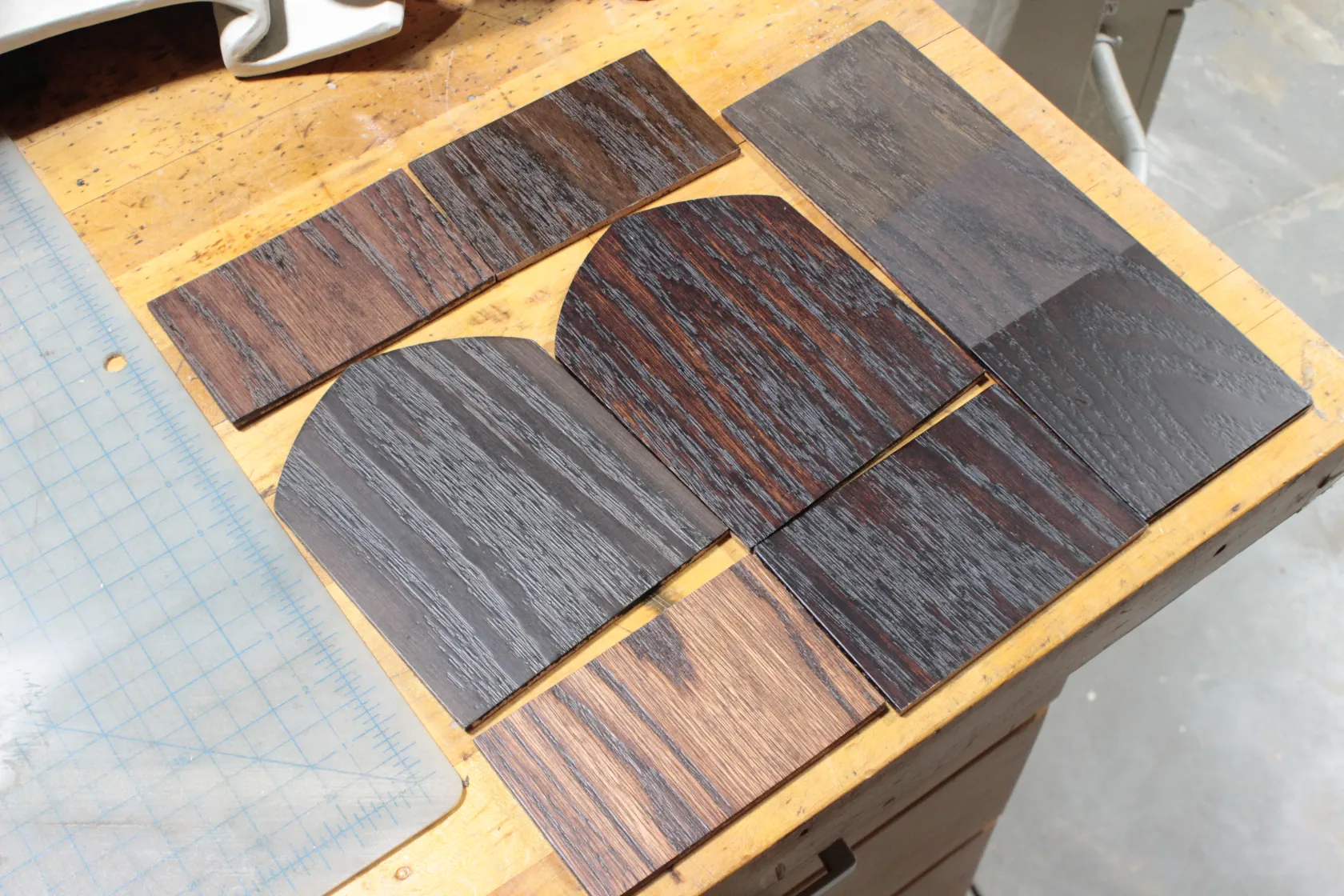
- Create and mail range of samples bracketing the color on the supplied photo.
- Client chooses one or two and provides commentary on darkness, sheen and color.
- Steps 1 and 2 are repeated until the customer selects one.
- Create a finishing story board (sample on far right) and a larger matching sample to mail to the client for sign-off
Finish matching is too complex a topic to delve into here. But the basic principles are described below for those interested.
Click here for the simple version of stain-matching.
Wood stain colors are matched primarily along three ‘axis’.
- Light/Dark
- Red/Green
- Blue/Yellow
Compare the sample to the target color and decide where it falls on those three qualities. So our client would reply with something along the line of: “we like sample B but it is too light and maybe too yellow. Sample C is too dark and not red enough.”
ΔW = W × C × ΔMC
Translation: wood moves. It grows and shrinks as relative humidity changes. The difference between Arizona and Illinois can be extreme and these pews needed to handle the transition and settle comfortably into their arid new home. Wood & moisture explained
Most potential issues are eliminated by taking advantage of the relative stability of long grain to make frames or by aligning cross-grain elements with each other. Joints where the cross grain is less than 8″ wide are acceptable when using kiln-dried wood and PVA glue for an indoor environment.
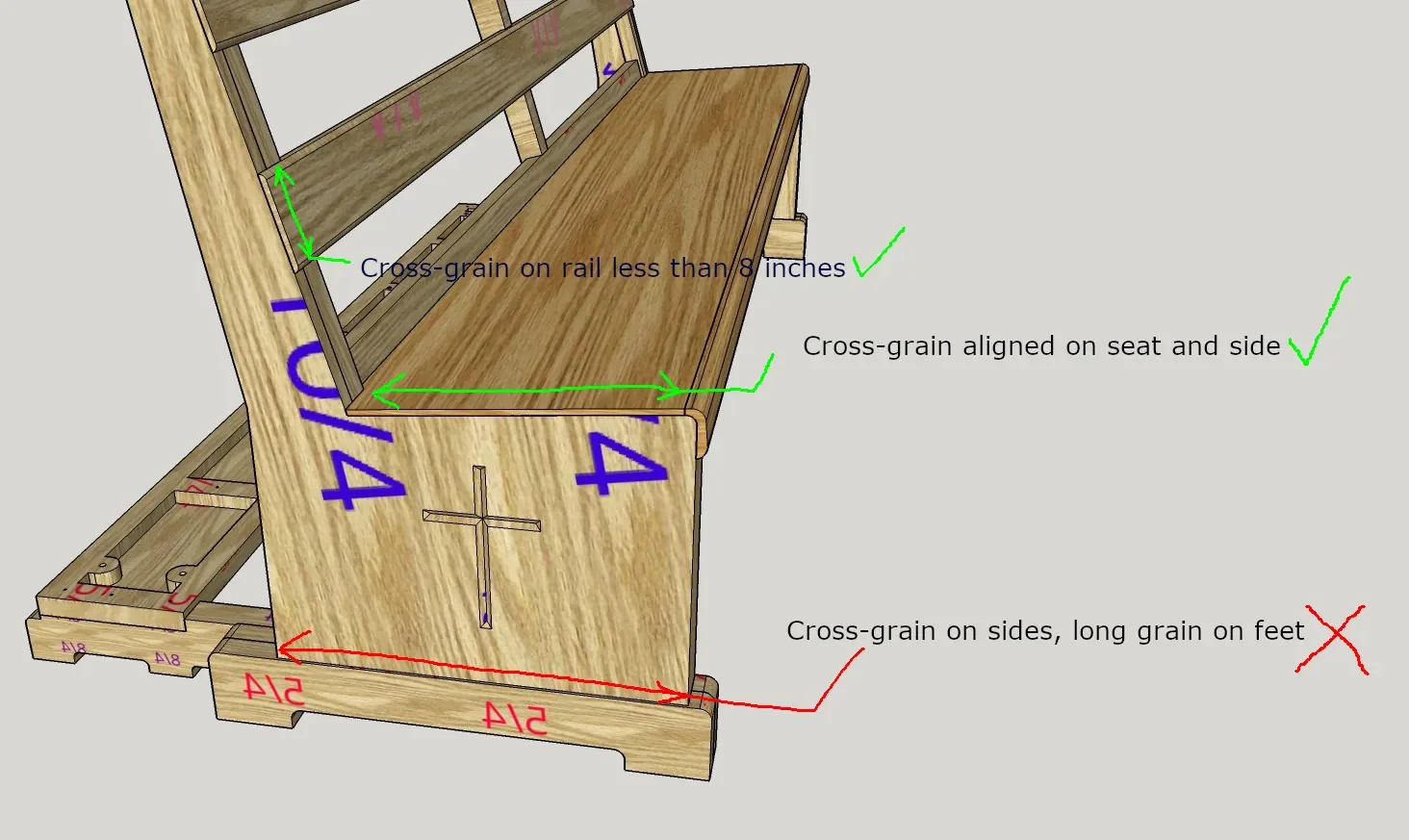
Problem:
The joint between the feet and the sides is a 17.4″ cross-grain intersection.
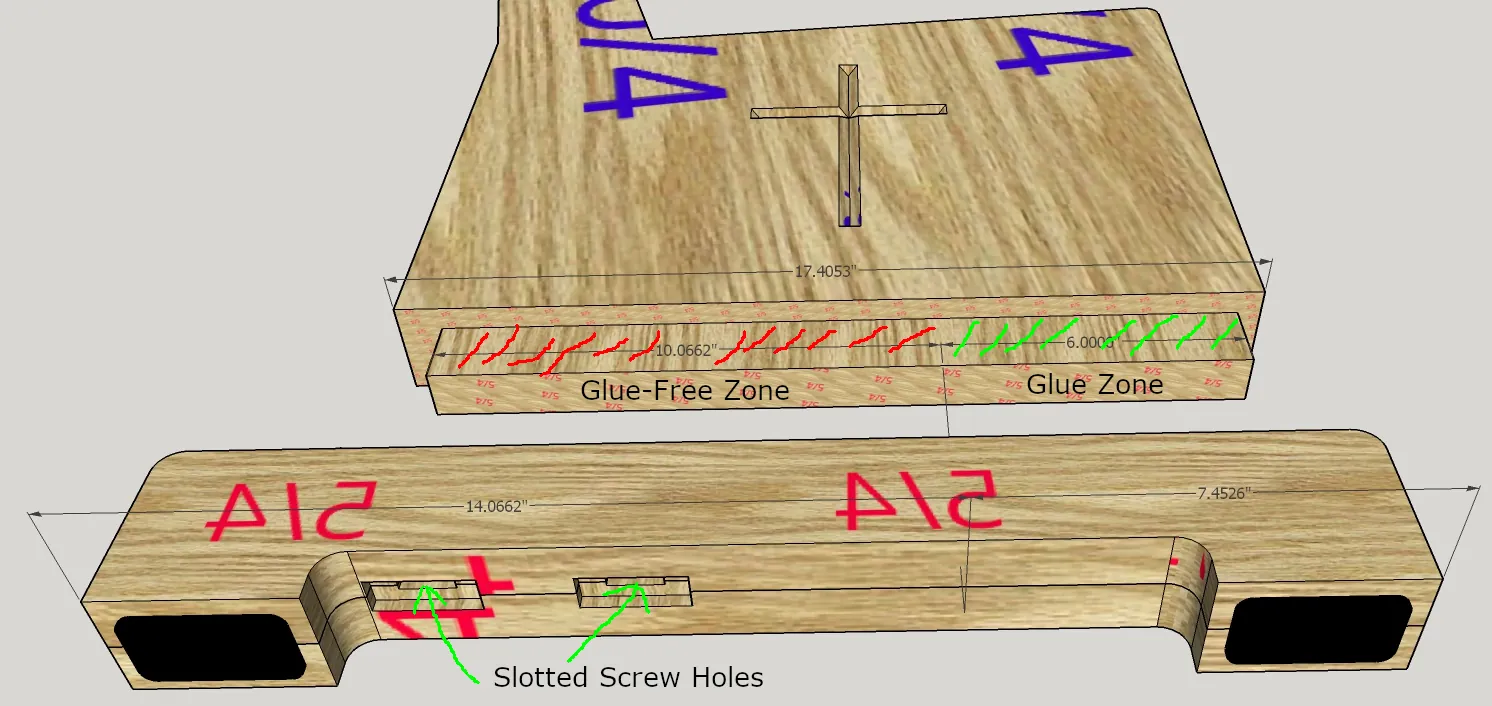
Solution:
Glue the front portion only. Slotted screws secure rear while permitting side movement. Sitting closes back of joint naturally; leaning won’t pry glued front loose.
If you’re wondering what all the 4/4, 5/4, and 10/4 markings are in these renderings, that’s our method for labeling lumber thickness. We use custom textures in SketchUp to tally wood quantities before placing orders with the hardwood supplier.
Pack Flat, Assemble Strong
Most pews are shipped flat but also use floor fasteners to maintain structural integrity and/or avoid tipping. Our pews are free-standing thus require furniture-grade joinery and the stability of a bench.
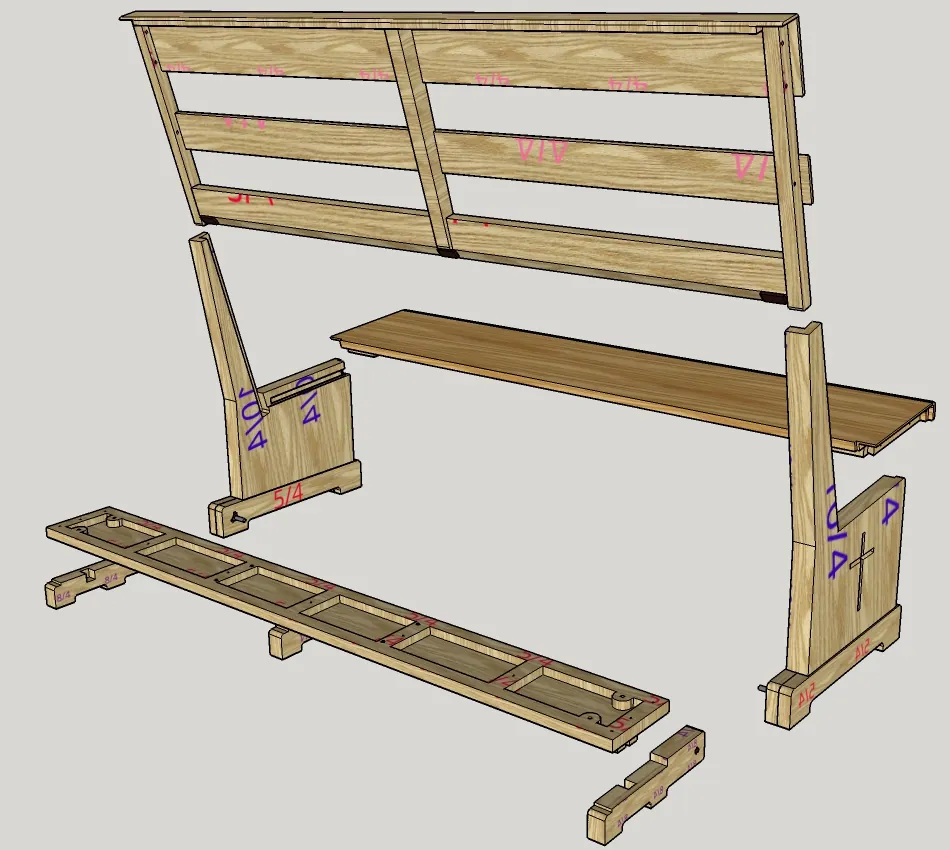
Fasteners alone won’t stand the test of time. Screws can wiggle loose when subjected to shearing loads or repeated flexing. They are effective at resisting withdrawal loads (try pulling a screw straight out). Using screws makes it easy to disassemble/reassemble for transportation or refinishing. The actual load-bearing? That is handled by properly fitted wood-on-wood joinery.
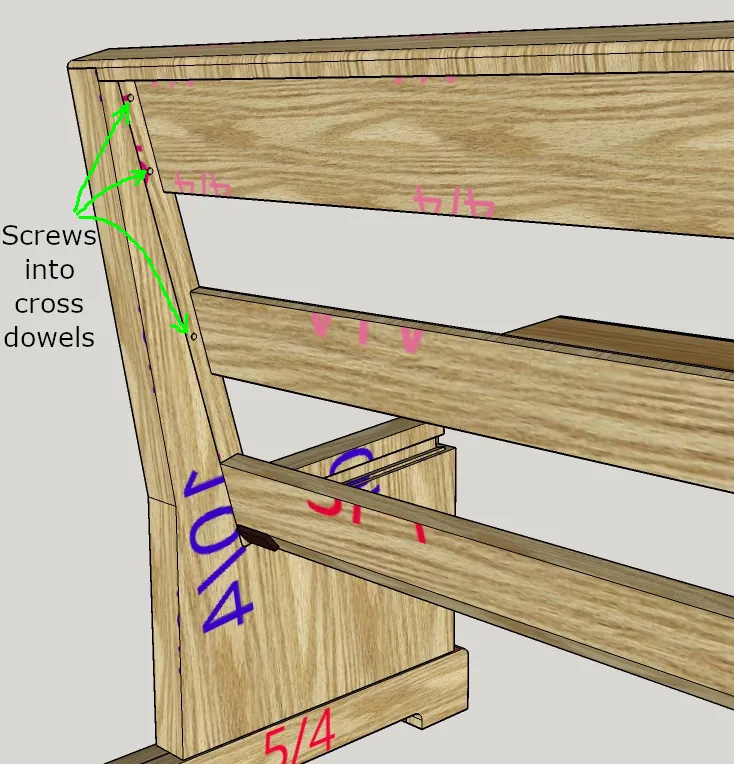
The screws on the pew ends are to lock down lateral motion by resisting withdrawal loads. The weight of congregants leaning back pushes the back into supporting wood on the ends.
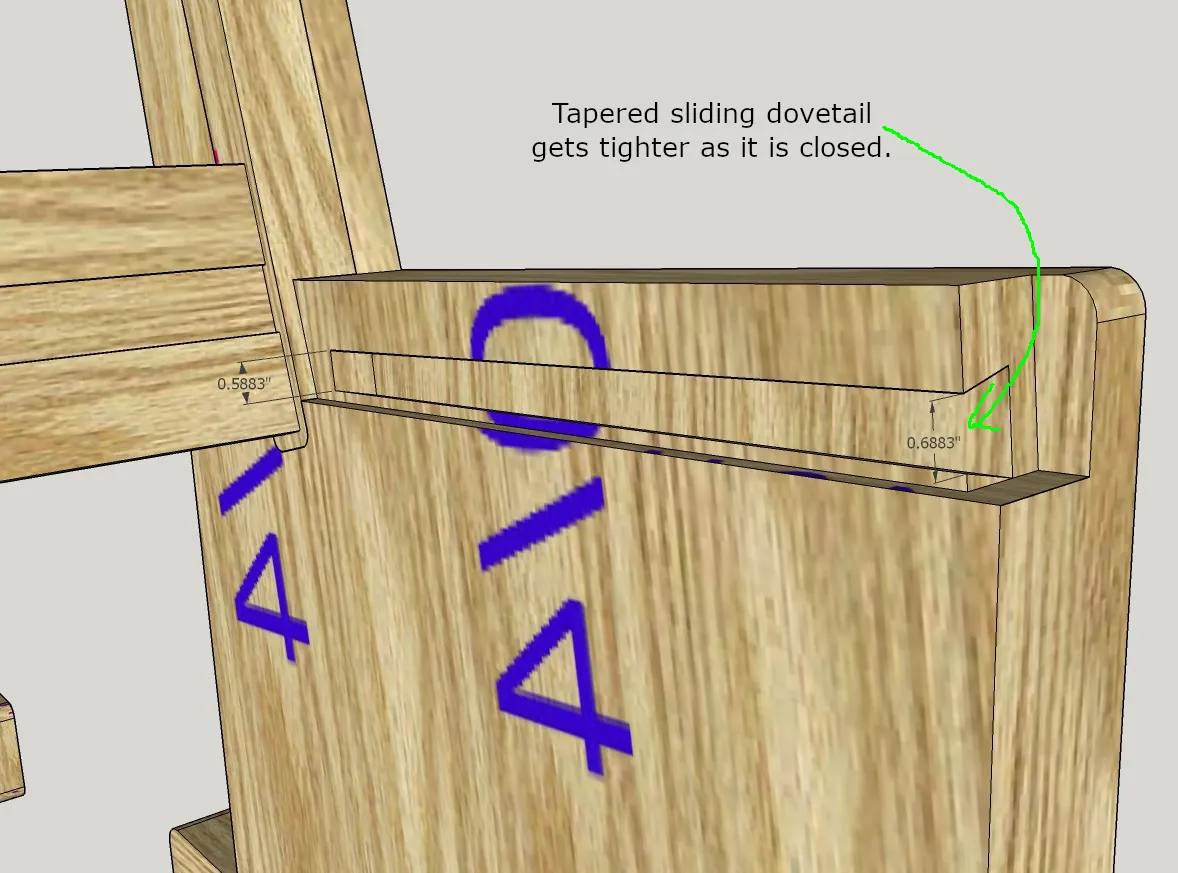
In the second image, a tapered sliding dovetail joint provides extra lateral support but also, the load bearing support from below.
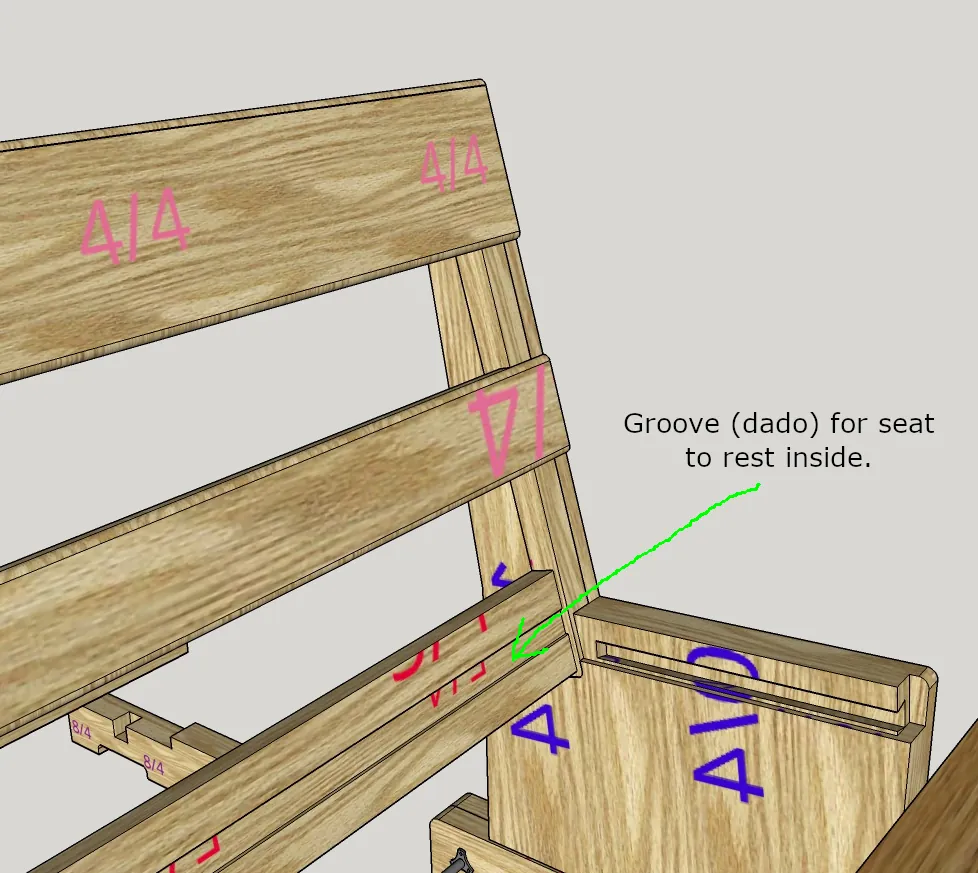
The seats slide into a dado on the back (third image) so the stiffness of the back is used as a structural beam–preventing sagging along the length. Pocket screws are used on the bottom of the seat to keep it tucked inside the groove. Again, this is a withdrawal load, exactly how screws like to be employed.
Taking a closer look at the dovetail joint:
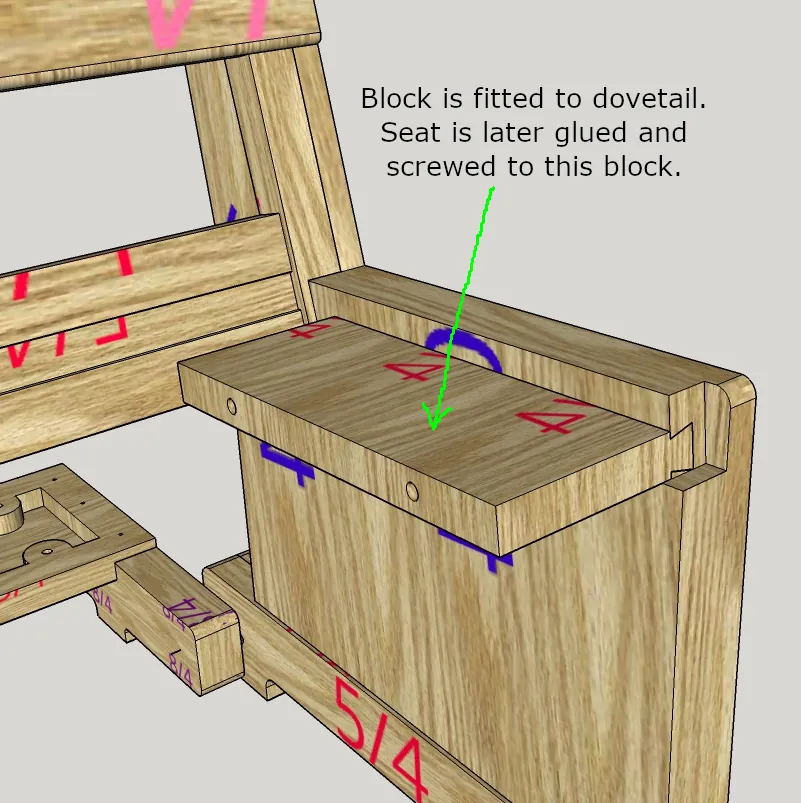
The blocks were fitted as separate pieces. Even with precision CNC milling for the pew ends and a dedicated tapering setup for the blocks, each piece required individual fitting to slide closed in just the right position.
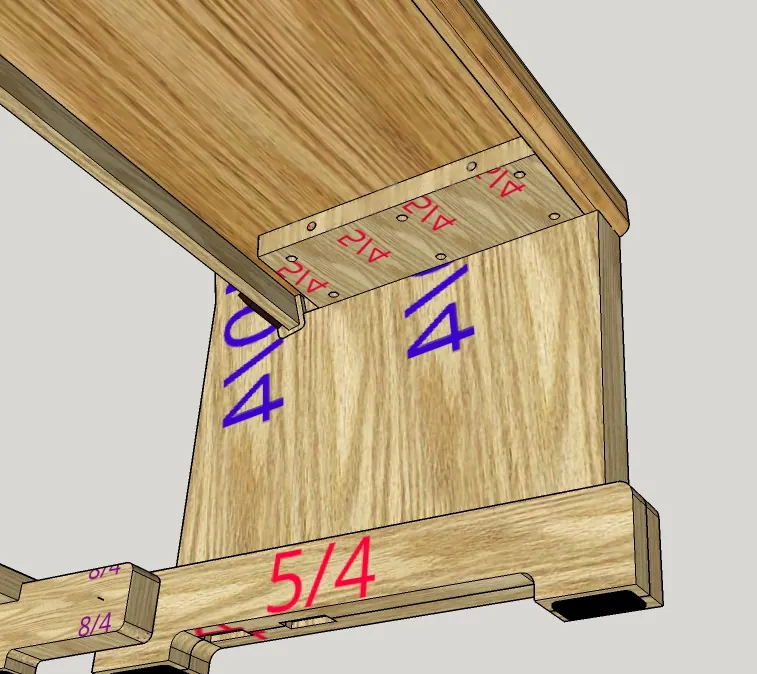
Once we got the block into position, glue is applied to the blocks then seats get pressed into place. Screws were used to clamp the parts together.
There are two additional screw holes on the edge of the block. Those are installed after assembly to pin the seat into place against the end.
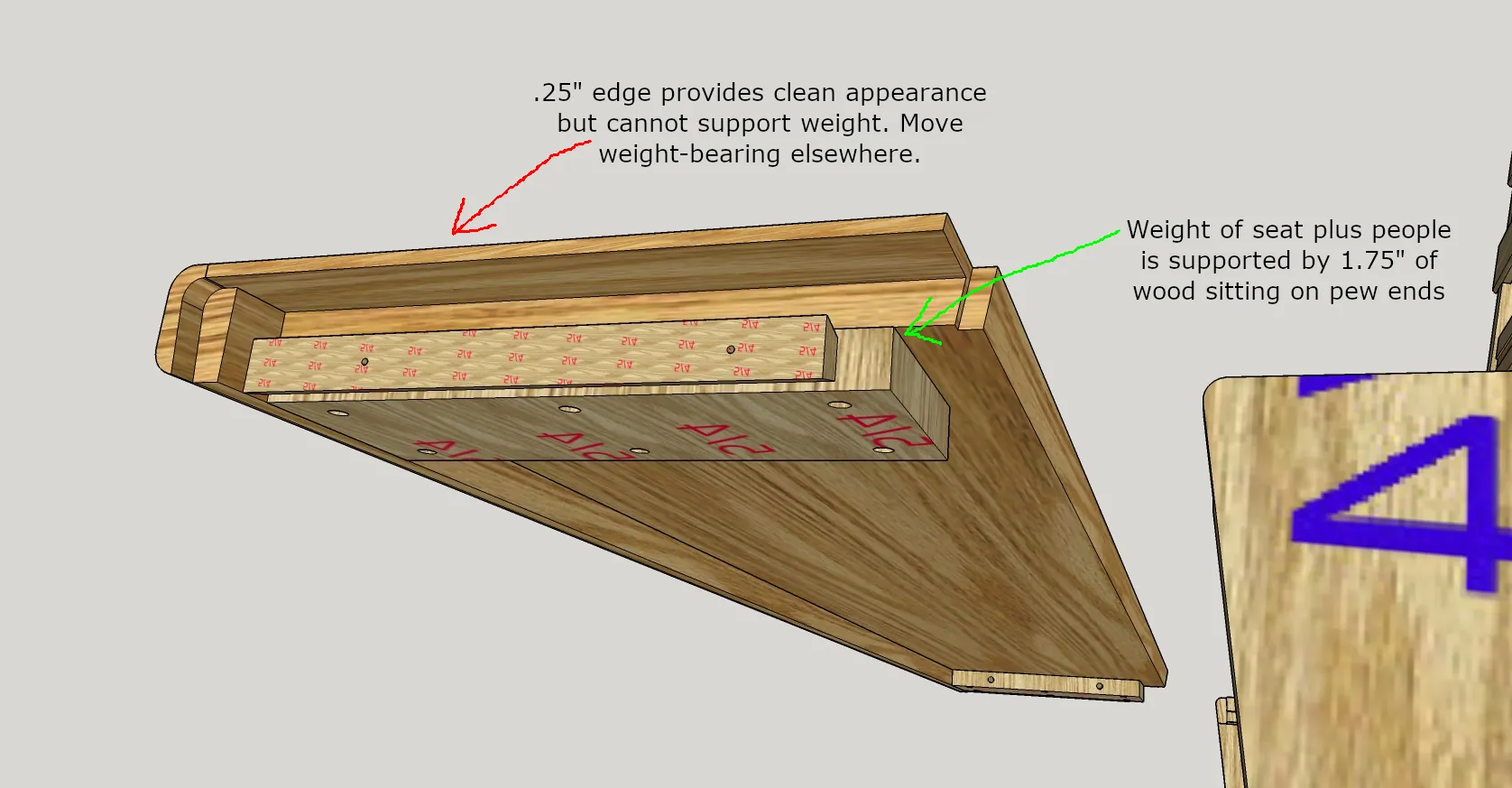
Here’s the business end of the seat. To get a clean appearance on the finished pew, we moved the support under the seat. The 1/4″ band hides the end grain of the top edge of the pew side and leaves just a narrow band visible on the seat end.
Production Photomontage!
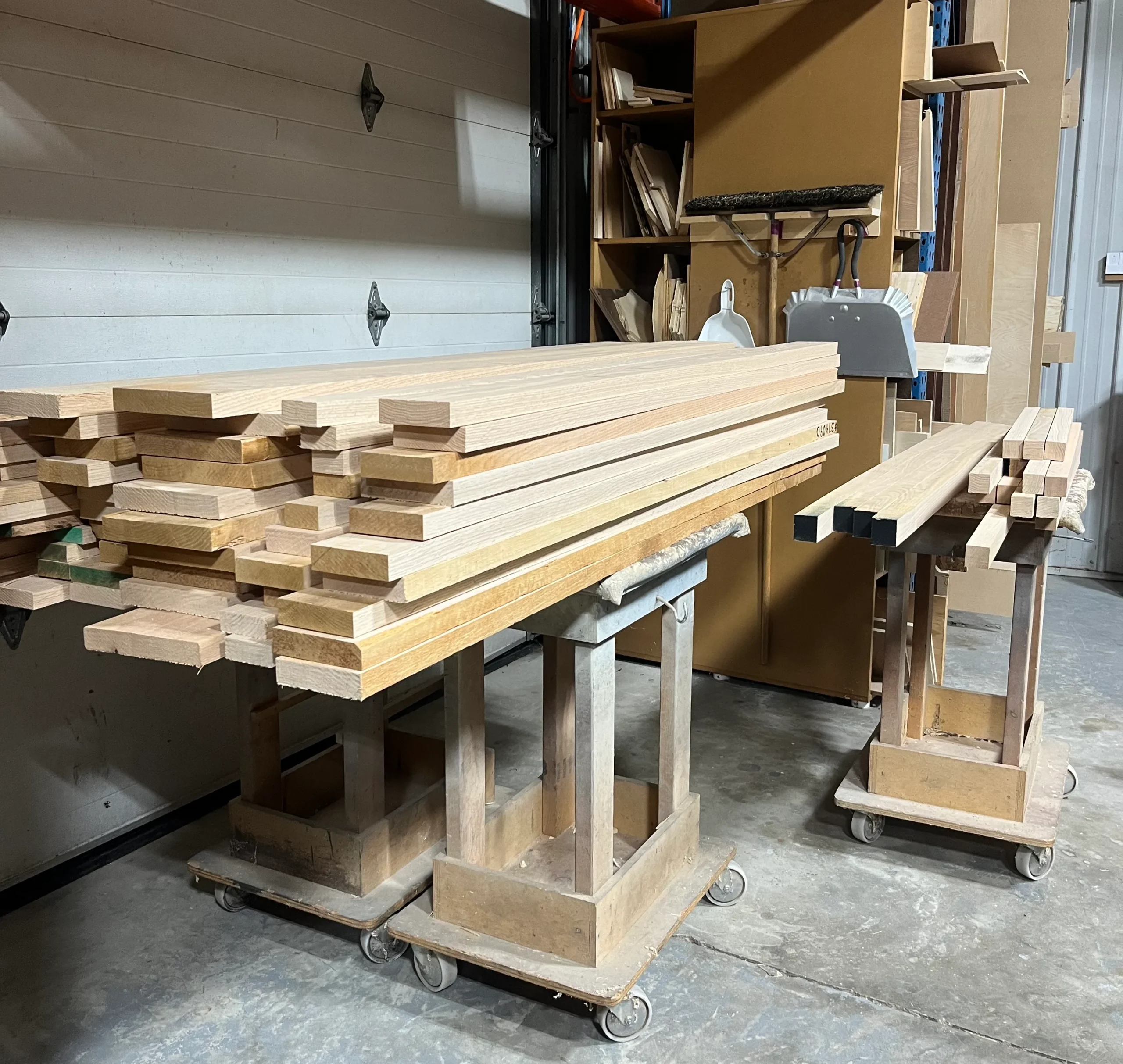
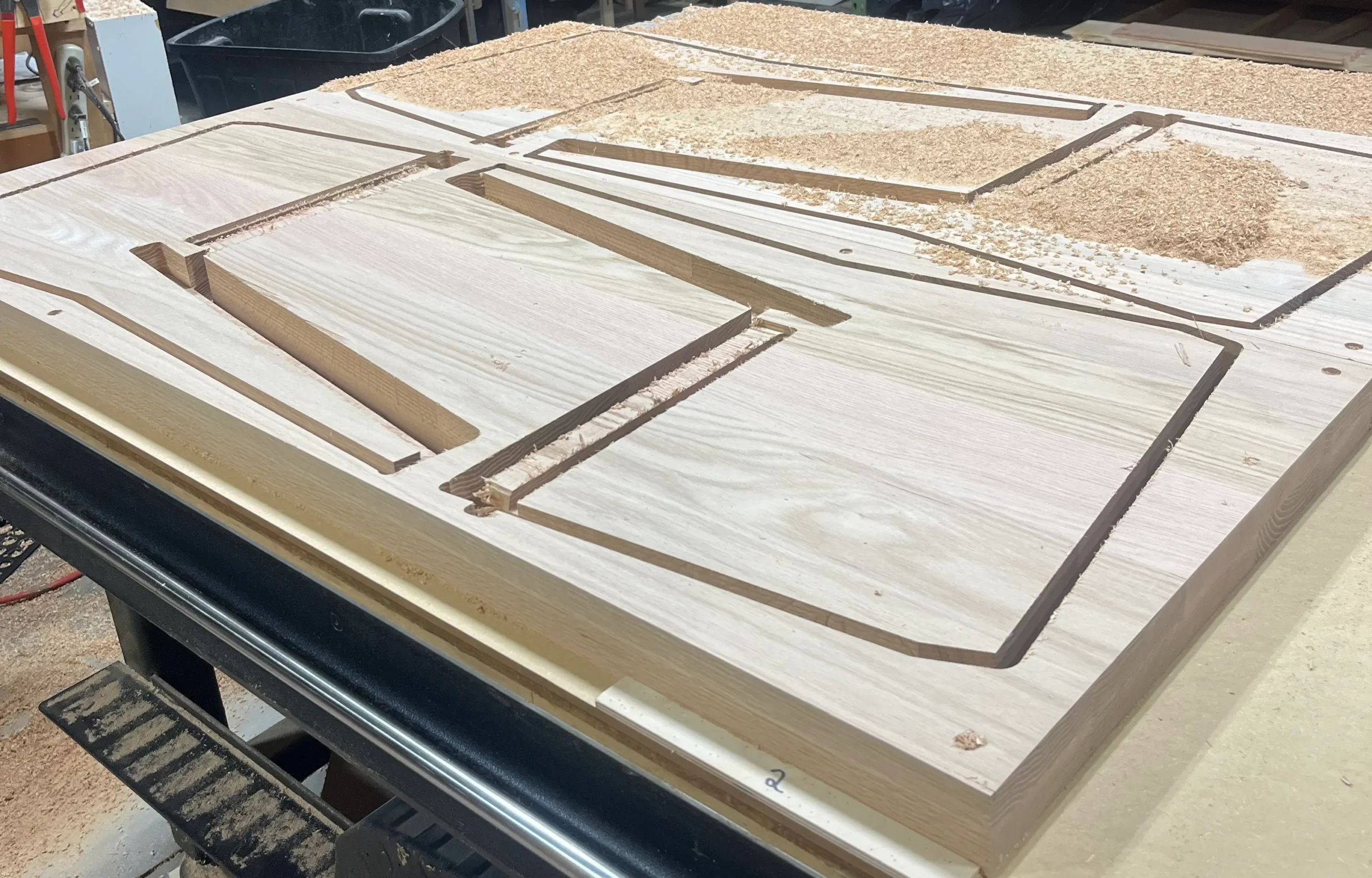
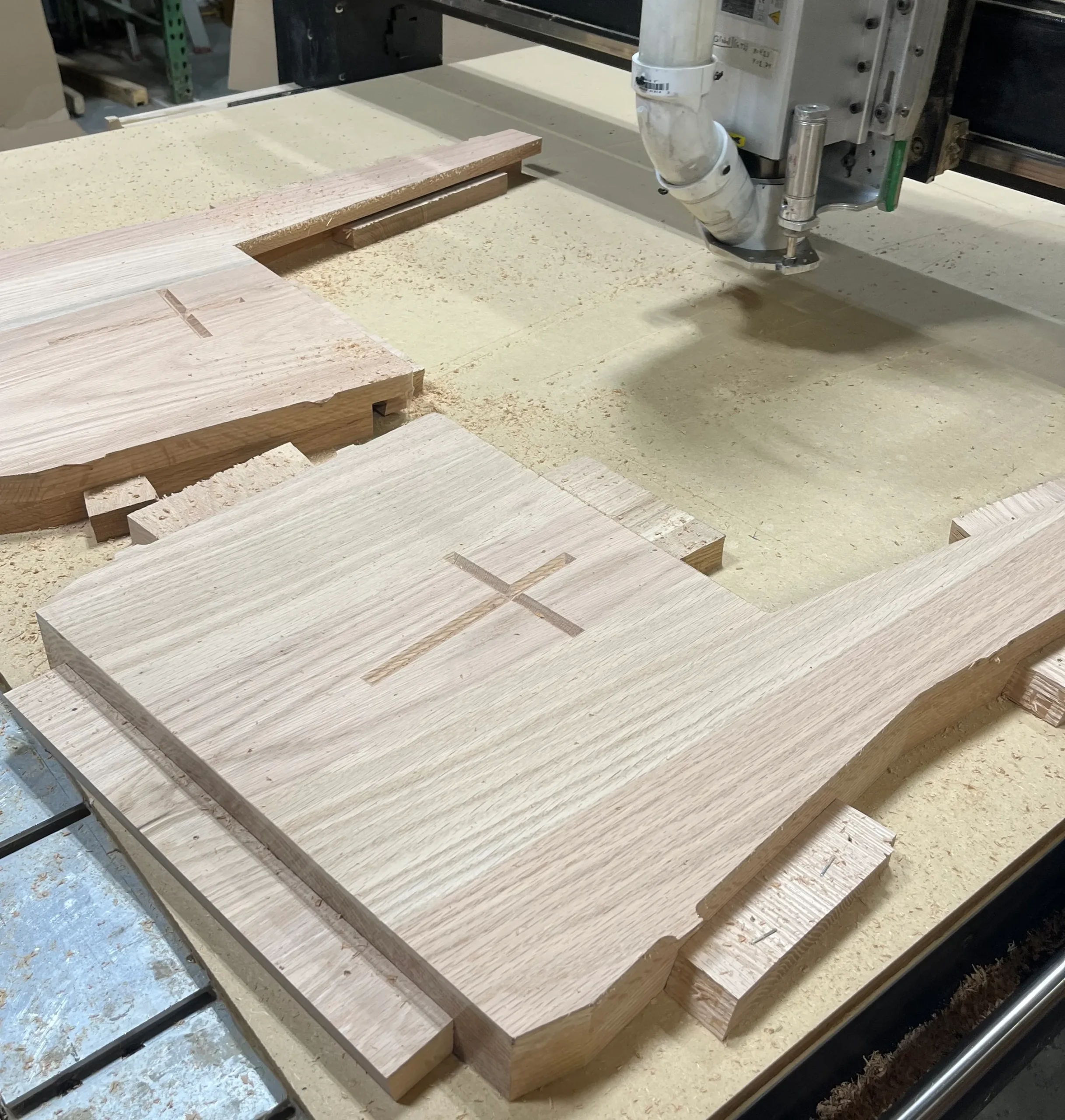
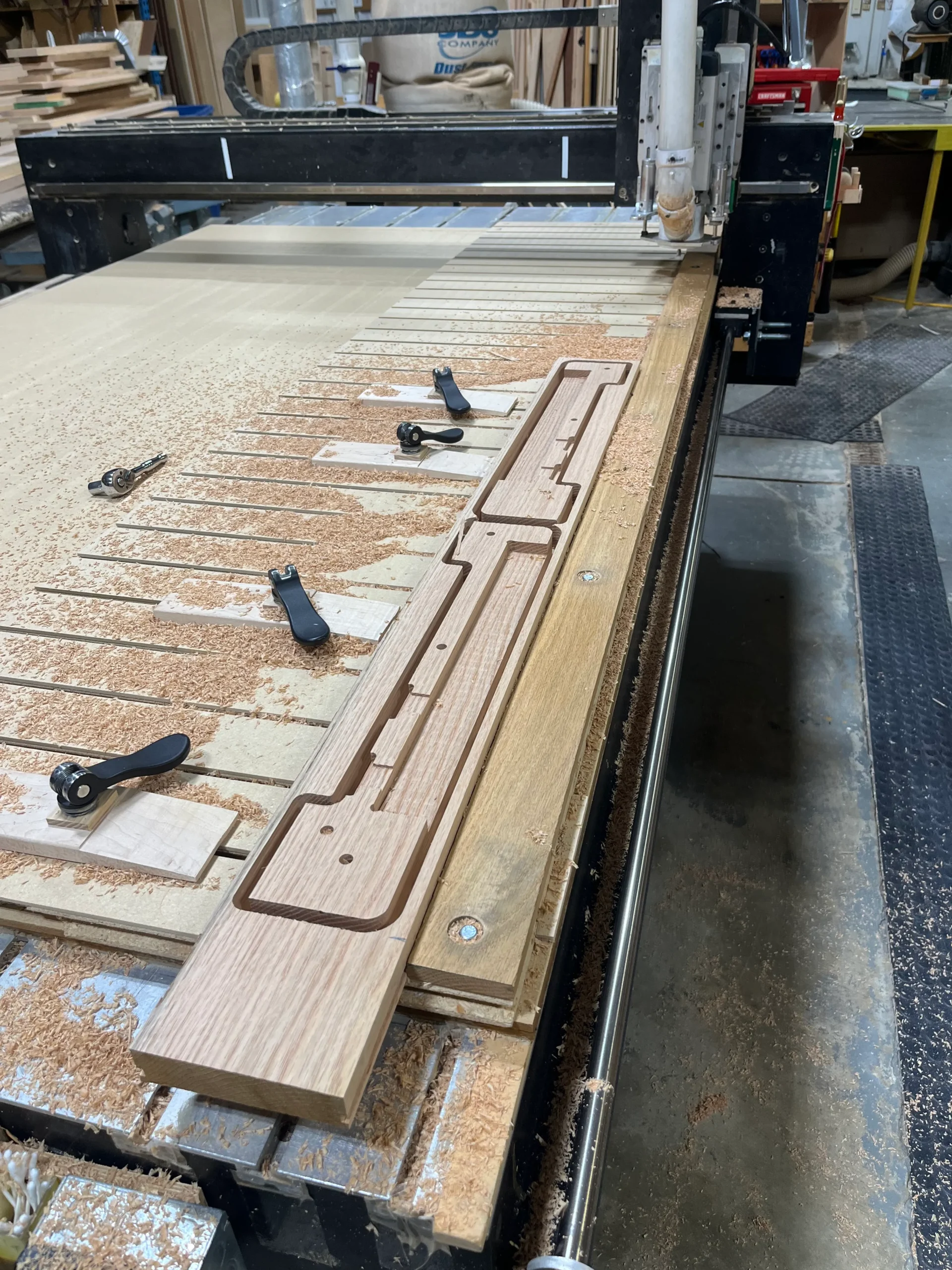
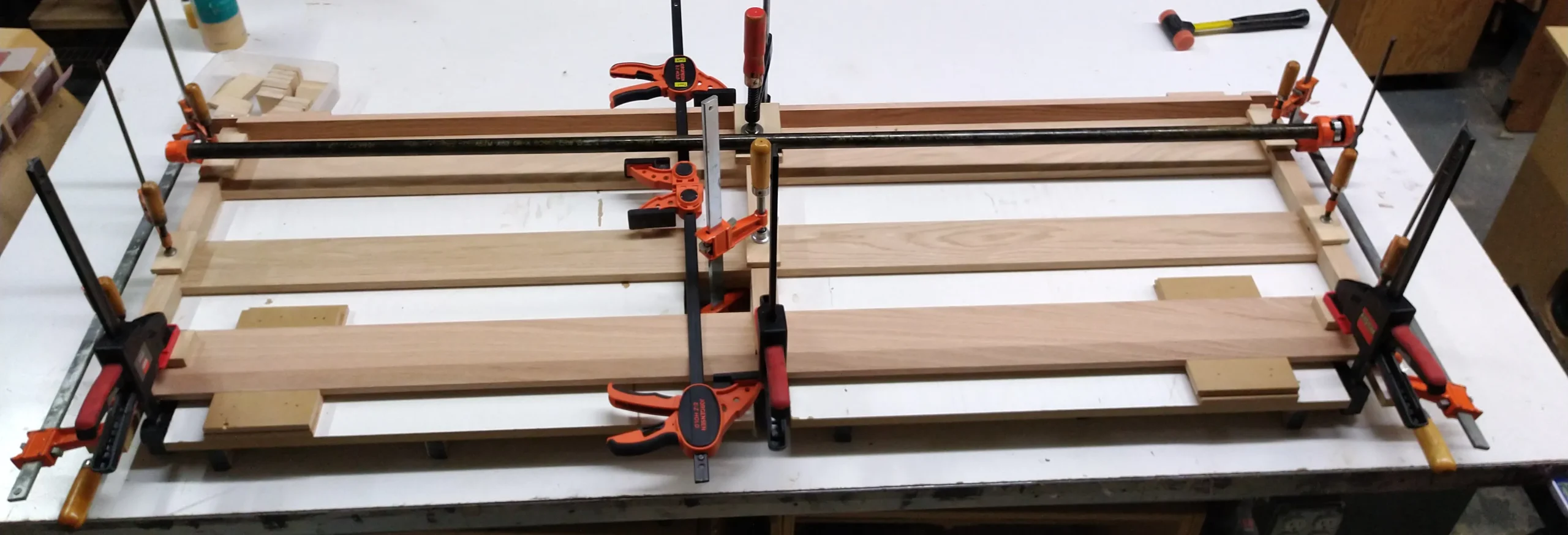
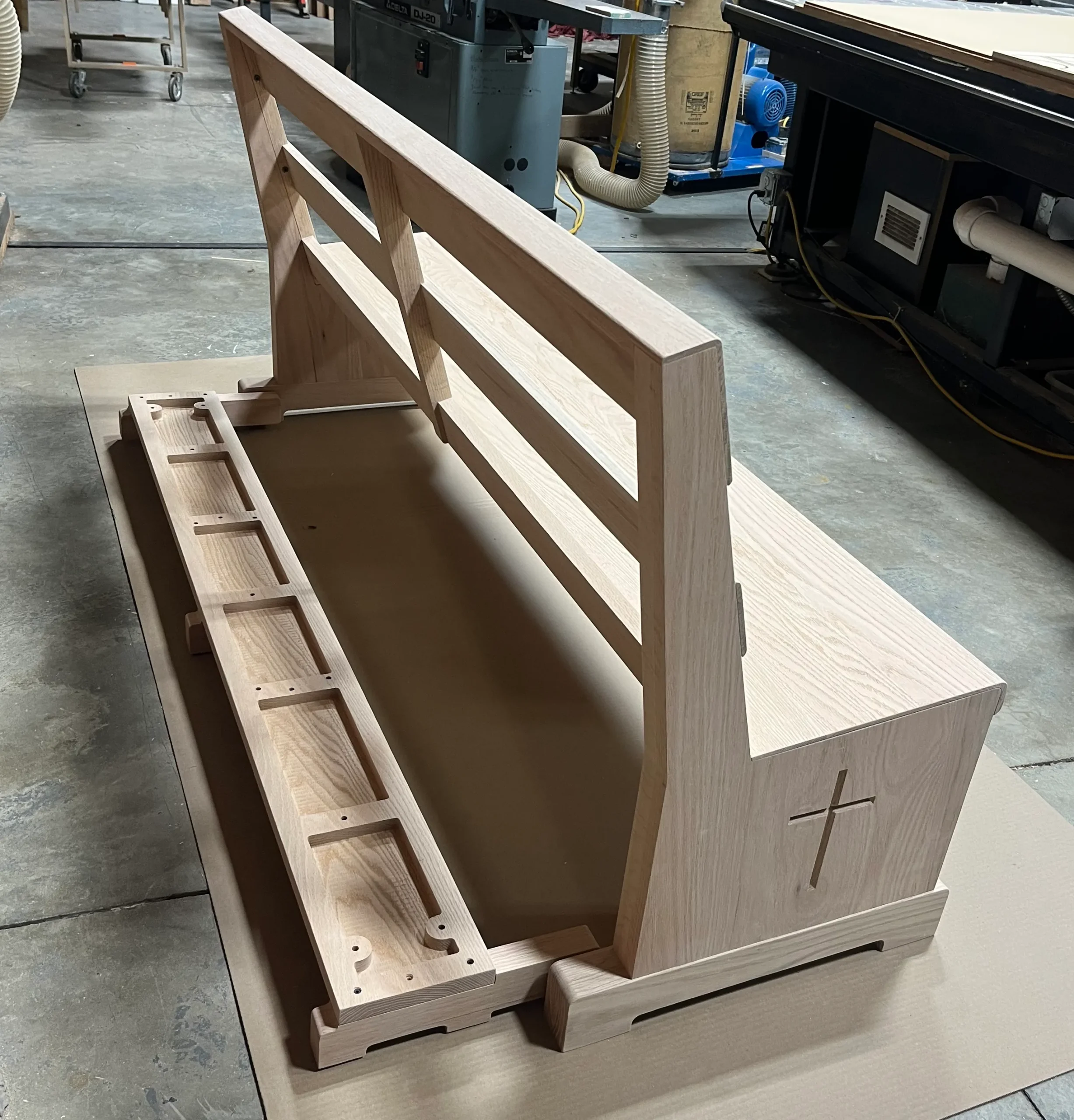
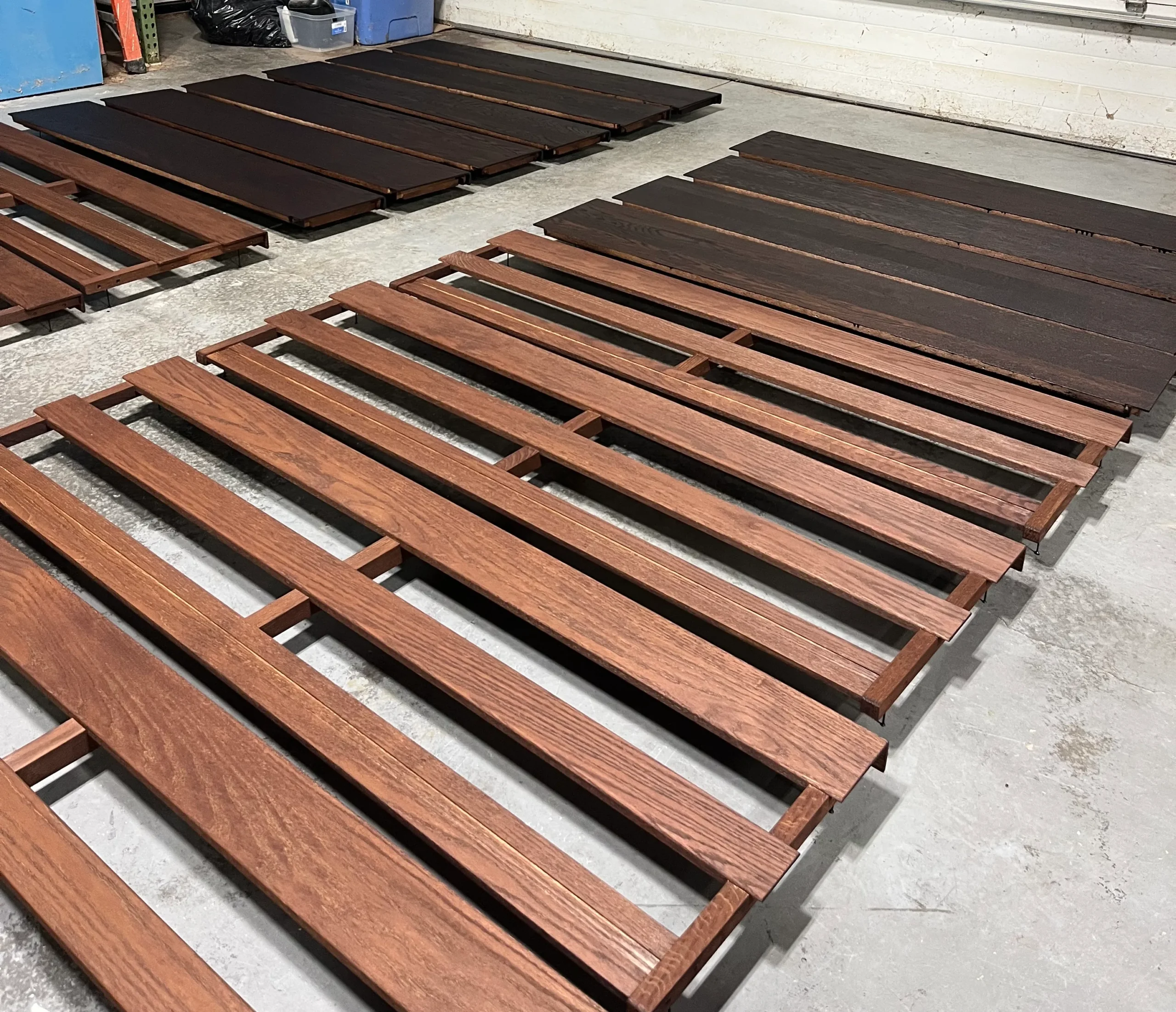
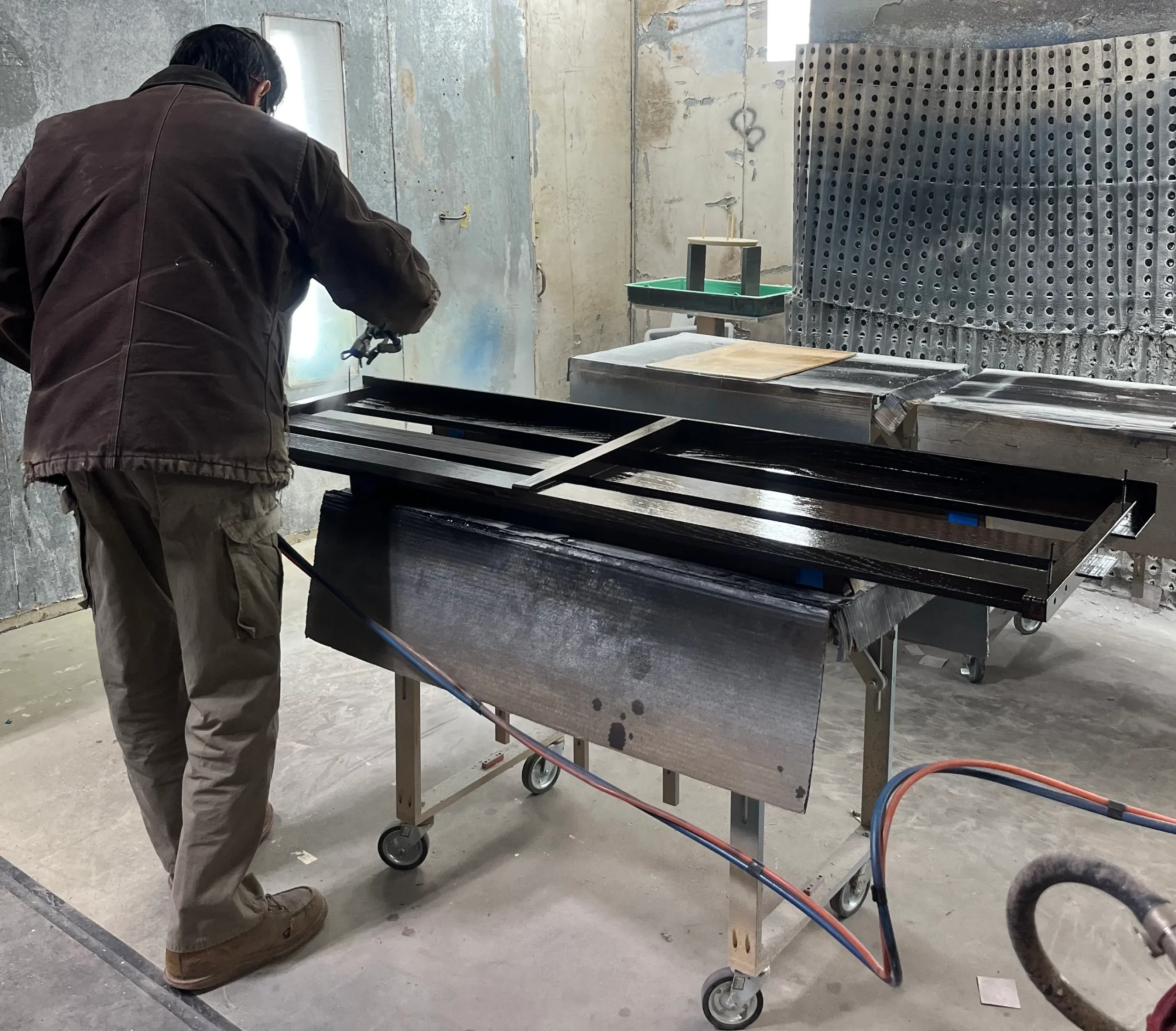
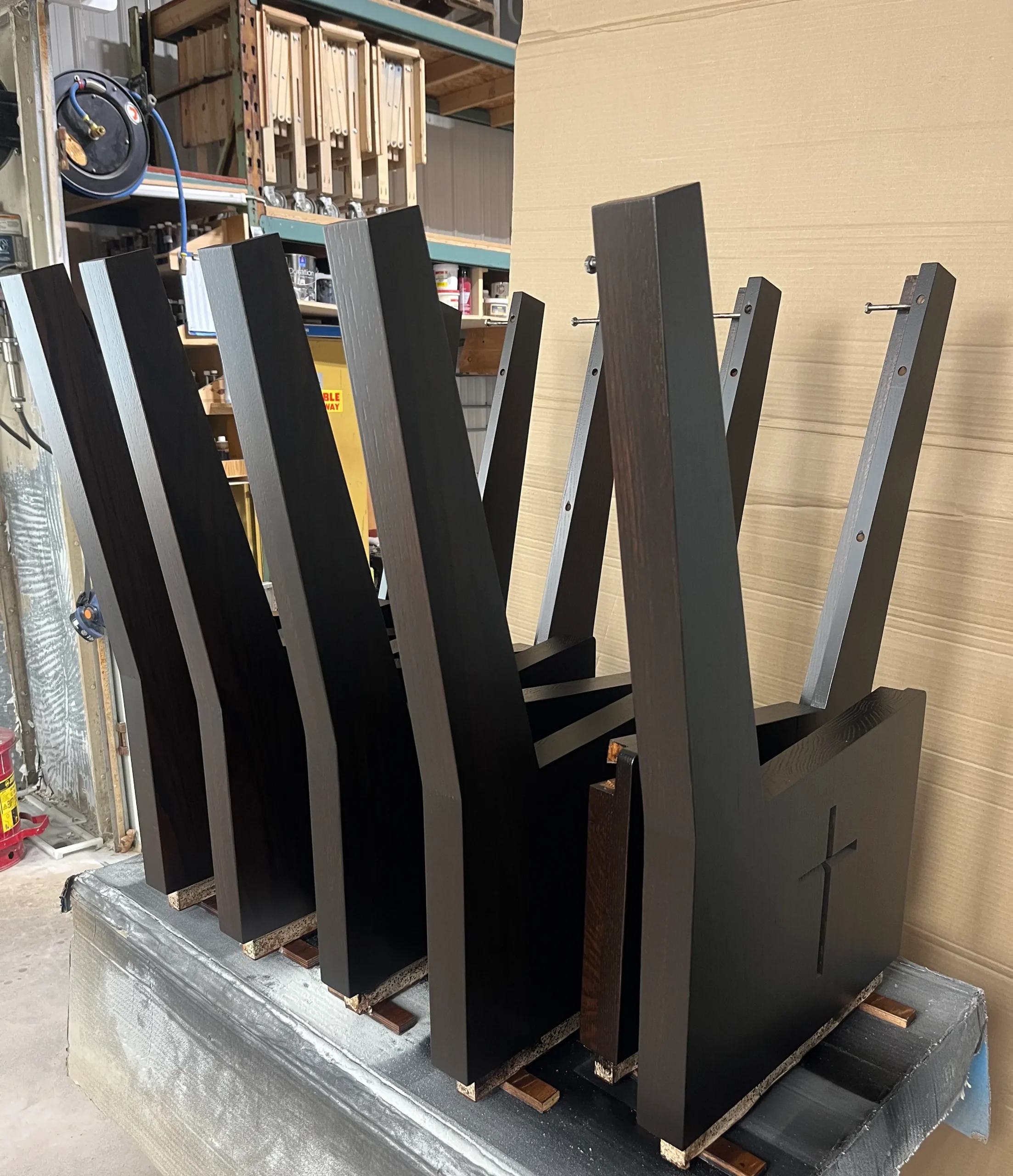
Going out West
The pews were produced in Aroma Park, Illinois so the round trip journey to deliver them was 3,290 miles. Rather than use a box truck, we opted for a more efficient form of travel.
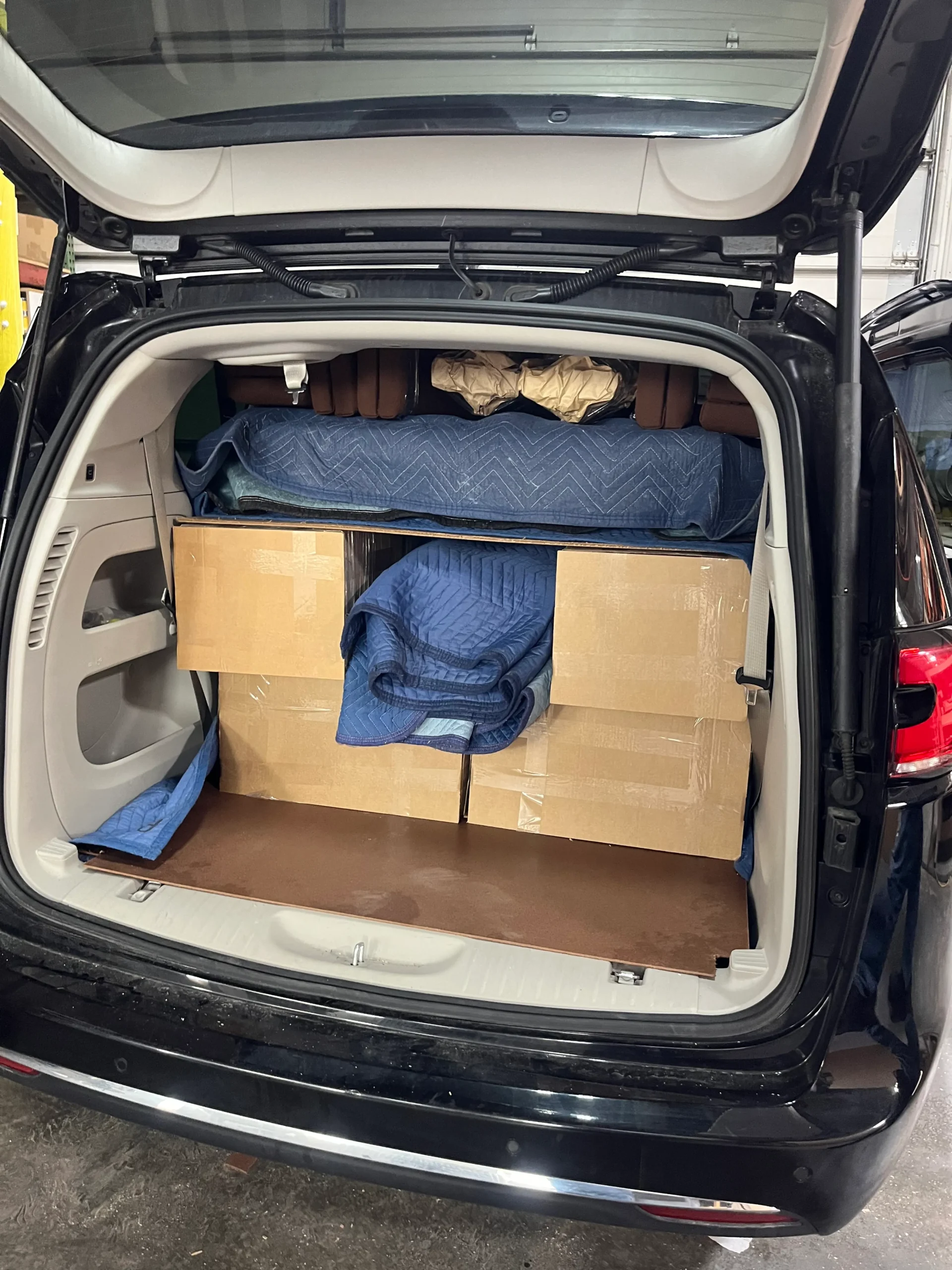
Ten 6′ long pews flat packed inside a Chrysler Pacifica with room enough to spare for luggage.
- 28mpg average highway fuel economy
- Access to top level parking lot at Holy Cross chapel
- Access to the 89A switchback from Flagstaff to Sedona
- Better driving experience than a box truck
Our client was paying for the cost of transportation. We used the most efficient option that would safely deliver these to Sedona, saving them over $600 in fuel costs alone.
Installation!
Watch the pews take their sacred place–filmed by Chapel of the Holy Cross staff.
Early June–A Final Addition and Completion
About three months after the install wrapped up in late February, we were contacted about an issue that, in hindsight, was obvious but had slipped past the design phase. Our methods for accounting for wood movement were documented earlier in this article, but sometimes one needs to look a little deeper to spot the less obvious tripwires hiding in plain sight.
The report: kneelers are sticking. We used quality stainless steel pins and bronze sleeve bearings for the action so the hardware was not the culprit. A quick video from the chapel staff showed us the problem was in the wood. The issue is explained below.
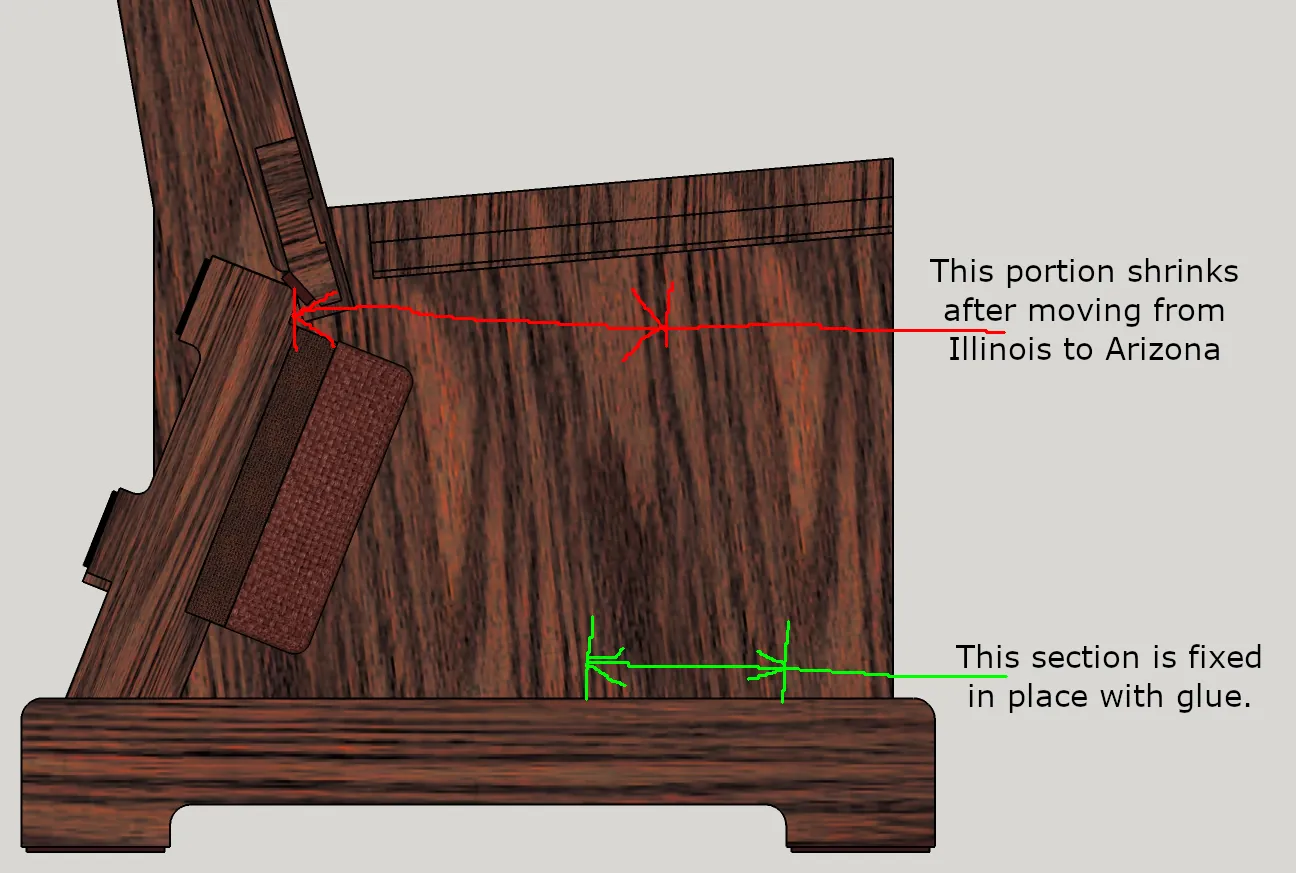
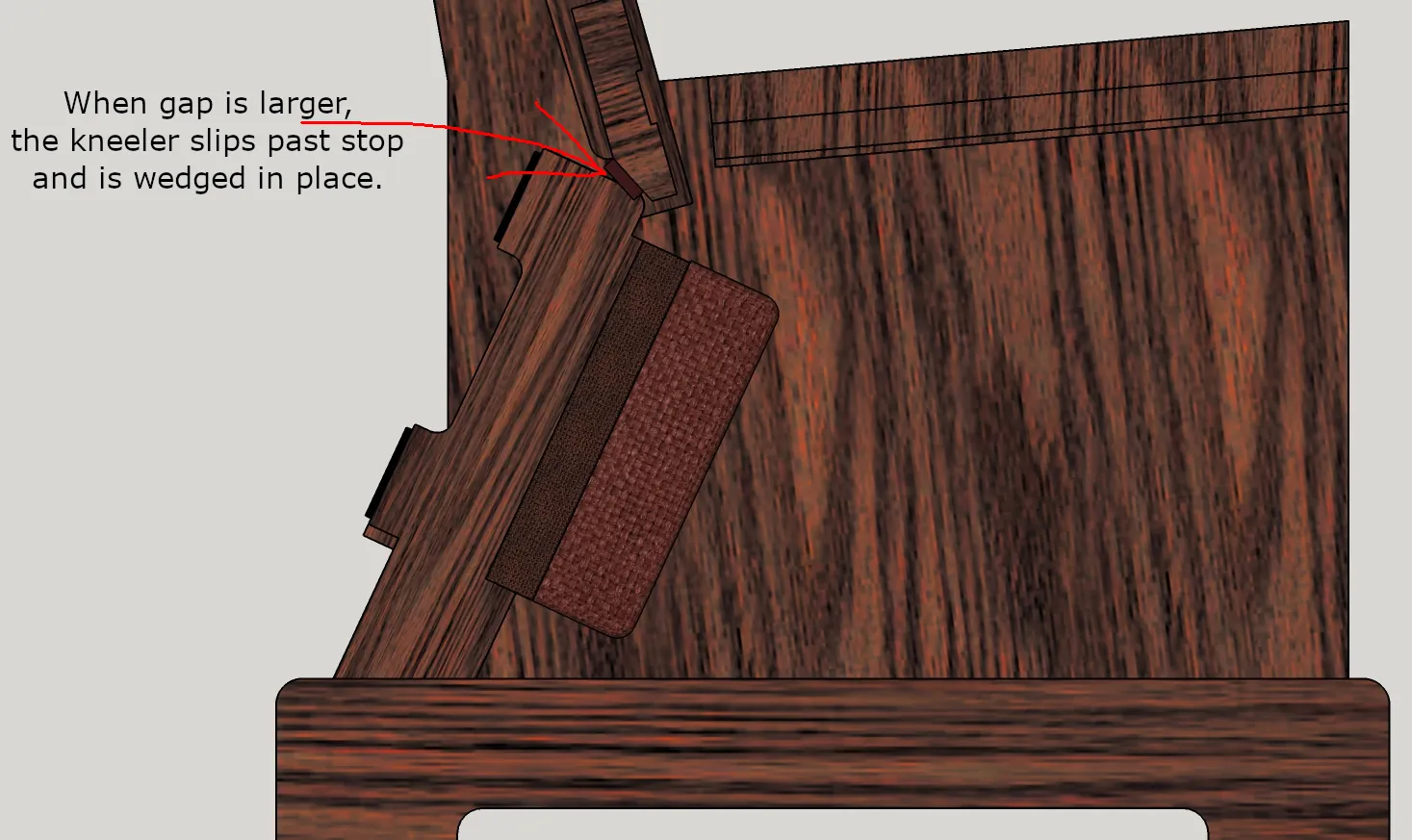
The original kneeler used the back as a stop. This gave us a clean, minimalist appearance. But it also separated the pivot point and the kneeler stop by roughly 9″ of wood that could shrink an 1/8″ as the pews acclimated to Arizona’s climate.
This is clearly a case where form overruled function and the balance between the two was lost. To address this problem, we opted to place a more conventional kneeler stop on the foot, ensuring the stop and pivot point remained in the same position relative to each other regardless of how the wood moves.
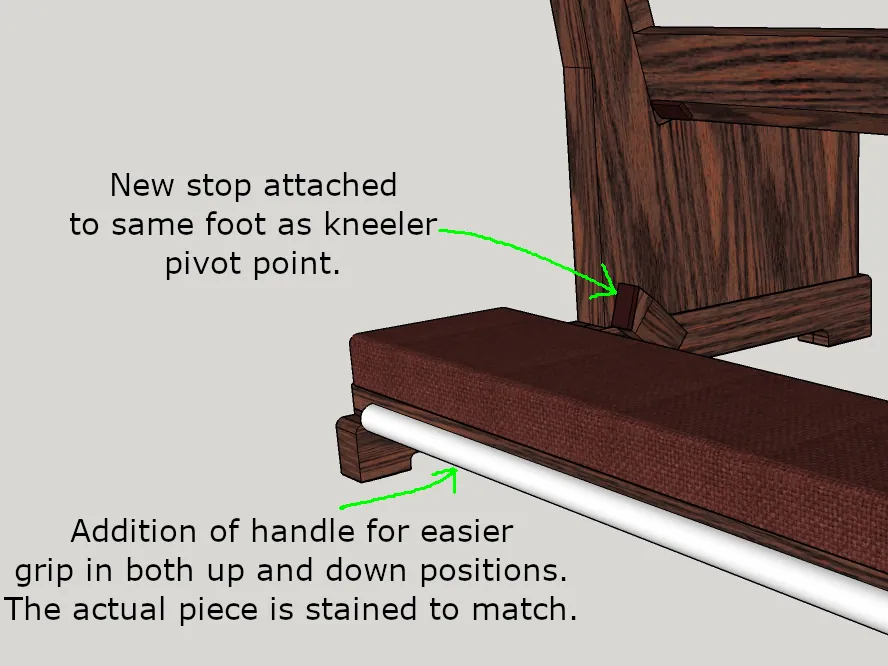
The addition of a custom-designed stop restored function and allowed us to retain a pleasing form as well. While we were doing this, we also added the handle depicted in white (but stained to match in reality). Though this was not directly related to the sticking issue, customer feedback indicated this would greatly improve ergonomics.
Implemented in July 2025, the fixes have now proven to be an effective solution, with nearly a year of service confirming their reliability.
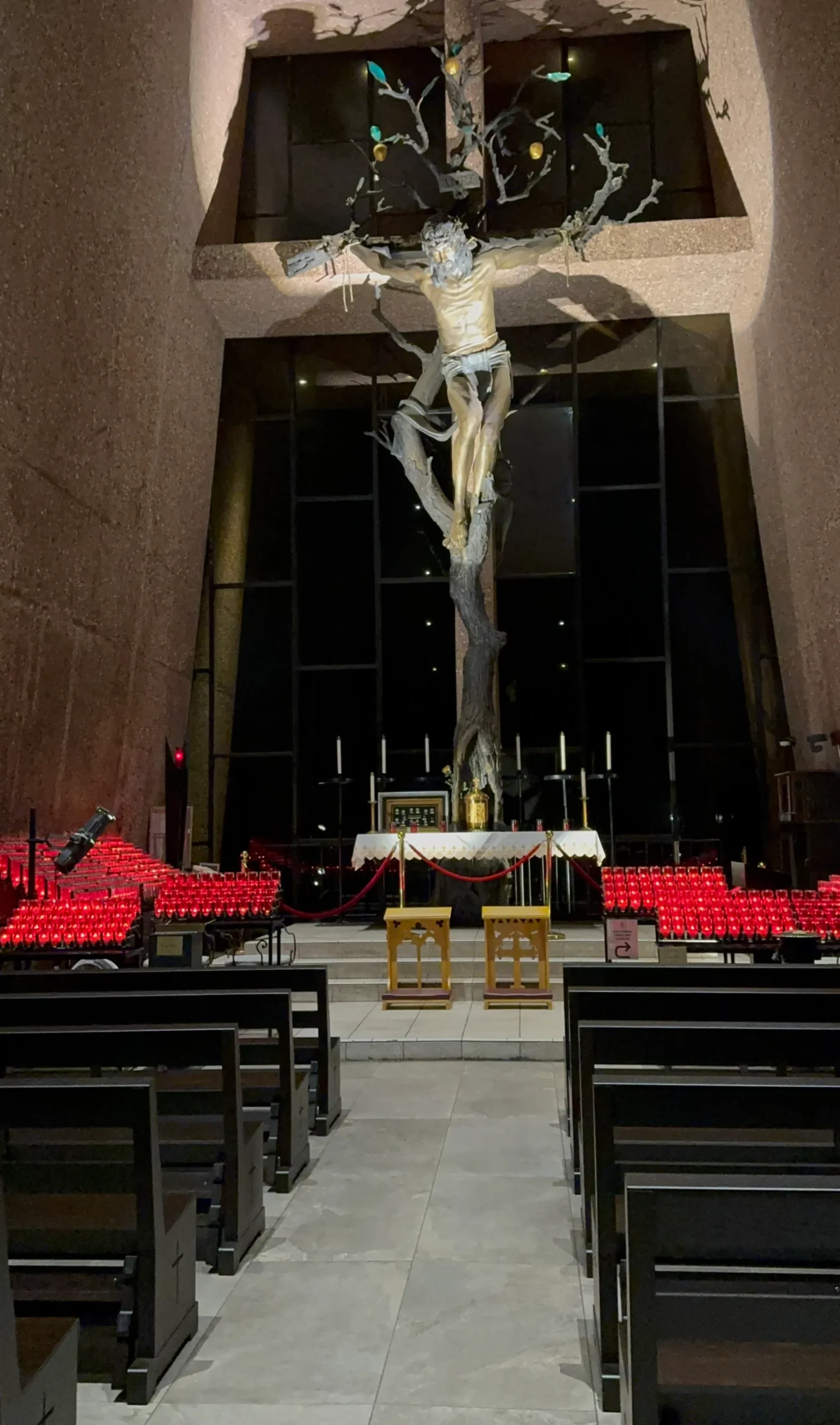
Photo provided by courtesy of the staff at Chapel of the Holy Cross.
Thank you for this, entrusting us with this project and the collaboration throughout the process.
And finally, a thank you also to the patrons who supported the project.